
What Is a Good GPA? Averages and Every GPA Explained
 Odeh Ahwal7 min read
A good GPA is 3.0 or higher on the standard 4.0 scale. That is a B average and matches the overall U.S. high school average. A 3.5 or higher is strong, and the most selective colleges usually look for 3.7 to 4.0, since college-bound students now average about 3.4.
Key takeaways
- A 3.0 GPA is solid: a B average that meets most college and graduate school minimums.
- A 3.5 or higher is strong, and 3.7 to 4.0 is excellent on the 4.0 scale.
- Grades are rising: ACT-tested graduates averaged 3.37, up from 3.17 five years earlier (ACT, 2025).
- In 2024-25, about 61% of 11th graders who reported grades said they had an A average (College Board, 2025).
- Weighted GPAs can go above 4.0 because AP and honors classes often count as 5.0.
A GPA turns years of report cards into one number, so it is natural to wonder whether yours is good, average or something to worry about. The honest answer depends on where you are (high school, college or applying to grad school) and on which scale your school uses. This guide gives you the plain numbers: what each GPA from 2.0 to 4.0 means, what the national averages are, and how weighted and unweighted GPAs differ.
What counts as a good GPA?
On the standard 4.0 scale, a 3.0 is a solid GPA. It equals a B average and matches the overall U.S. high school average. Among college-bound students, though, averages now run higher because of grade inflation. Anything from 3.5 up is strong, and the most selective schools usually look for 3.7 to 4.0. What counts as good shifts with your goal:
| Your situation | Solid | Strong | Very competitive |
|---|---|---|---|
| High school, applying to most colleges | 3.0 | 3.5 | 3.8 and up |
| College, for internships and jobs | 3.0 | 3.5 | 3.7 and up |
| Applying to graduate school | 3.0 (a common minimum) | 3.5 | 3.7 and up |
| Applying to medical school | 3.6 | 3.8 | 3.9 and up |
These are general guides, not official cutoffs; each school and program publishes its own ranges. The medical school row is higher because the bar really is higher: students who entered U.S. medical schools in fall 2025 averaged a 3.81 GPA, according to the AAMC. If that is your path, our medical school GPA calculator shows where you stand.
Is my GPA good? Every GPA from 2.0 to 4.0
Find your number below. The letter grades use the most common plus and minus scale (A- = 3.7, B+ = 3.3, B- = 2.7), but some schools skip pluses and minuses or set different cutoffs.
| GPA | Average grade | What it means |
|---|---|---|
| 4.0 | A | The top of the unweighted scale: straight A's. |
| 3.9 | A | Excellent. Competitive almost anywhere. |
| 3.8 | A- | Excellent. In range for highly selective schools. |
| 3.7 | A- | Very strong. Common Dean's List territory. |
| 3.6 | Between B+ and A- | Strong. Well above average. |
| 3.5 | Between B+ and A- | Strong. A half point above a B average. |
| 3.4 | B+ | Good. Right at the average for ACT-tested graduates. |
| 3.3 | B+ | Good. Above the overall high school average. |
| 3.2 | Between B and B+ | Above average, but not by much. |
| 3.1 | B | Around the overall U.S. college average. |
| 3.0 | B | Solid. The overall high school average, and a common minimum for colleges and grad schools. |
| 2.9 | Between B- and B | Just under average. A few strong grades can lift it past 3.0. |
| 2.8 | Between B- and B | Below average. Some programs with a 3.0 minimum will be out of reach. |
| 2.5 | Between C+ and B- | Below average. Worth a plan to raise it. |
| 2.0 | C | A C average. Often the minimum to stay in good standing. |
Is a 3.5 GPA good?
Yes. A 3.5 is above both the overall high school average (about 3.0) and the 3.37 average of ACT-tested graduates, and it puts you in range for most four-year colleges. At the most selective schools it is on the lower side, so strong test scores, essays and course rigor matter more there.
Is a 3.0 GPA good?
A 3.0 is a solid, average GPA. It means you earned mostly B's, and it meets the minimum for many colleges, scholarships and graduate programs. Because grades have risen, it now sits a little below the average of college-bound students, so it will not stand out at selective schools on its own.
Is a 3.7 or 3.8 GPA good?
Very good. Both are in A- territory and well above every national average in this guide. In college, GPAs in this range often meet Dean's List or honors cutoffs, but each school sets its own. The Dean's List GPA calculator shows what you need to get there.
Average GPA in the U.S.
There is no single national average, because it depends on who is counted. Here are the most recent figures from the organizations that collect them:
| Group | Average GPA | Source |
|---|---|---|
| All U.S. high school students | About 3.0 | College Board |
| All U.S. college students | About 3.1 | College Board |
| ACT-tested high school graduates (class of 2022, report published 2025) | 3.37 | ACT |
| Students entering medical school, fall 2025 | 3.81 (median 3.87) | AAMC |
| All medical school applicants, 2025 | 3.67 | AAMC |
Grades have been climbing fast. In a November 2025 research report, ACT found that the average GPA of ACT-tested graduates rose from 3.17 for the class of 2017 to 3.37 for the class of 2022, while their test scores slipped. ACT warns that this grade inflation makes high GPAs harder for colleges to read, which is one reason many colleges look closely at course rigor and test scores too.
College Board's 2025 SAT Suite Annual Report shows the same trend. Of the 11th graders who took the PSAT in the 2024-25 school year and reported their grades, about 61% said they had an A average (A+, A or A-), around 31% reported a B average, and about 8% reported a C average or lower.
How the 4.0 GPA scale works
Most U.S. schools turn each letter grade into points, then average the points. College Board uses this common conversion:
| Letter grade | Percent range | GPA points |
|---|---|---|
| A | 90-100 | 4.0 |
| B | 80-89 | 3.0 |
| C | 70-79 | 2.0 |
| D | 66-69 | 1.0 |
| F | Below 65 | 0.0 |
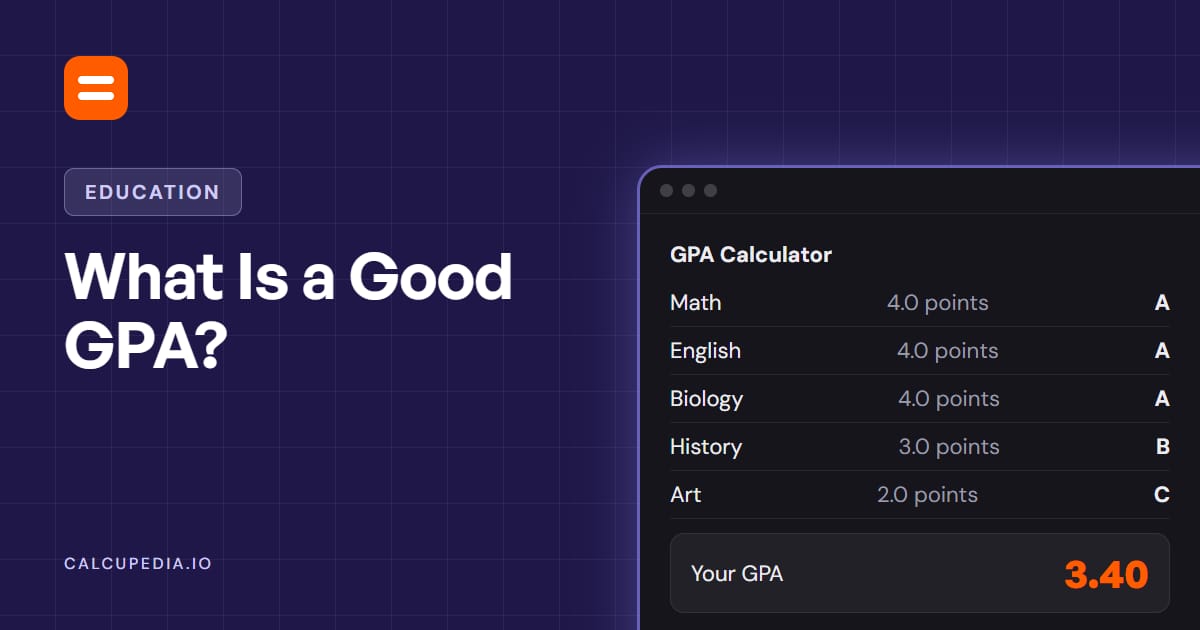
To find your GPA, add the points for each class and divide by the number of classes. For example, three A's, one B and one C give (4 + 4 + 4 + 3 + 2) ÷ 5 = 3.4. In college, each grade is also multiplied by the class credits, so a 4-credit class counts more than a 1-credit lab. Try it with your own grades:
Prefer a version built for your level? Use the high school GPA calculator or the college GPA calculator, which handles credit hours.
Weighted vs. unweighted GPA
An unweighted GPA uses the plain 4.0 scale, so 4.0 is the highest possible. A weighted GPA adds extra points for harder classes. Many high schools count an A in an AP or honors class as 5.0 instead of 4.0, which is why weighted GPAs can go above 4.0.
Weighting rules differ from school to school, so a 4.3 at one school is not the same as a 4.3 at another. To compare fairly, many colleges recalculate applicants' GPAs on their own scale. The weighted GPA calculator shows both numbers side by side.
What is a passing GPA?
A D (1.0) usually still earns credit for a single class, but a 1.0 overall average rarely keeps you in good standing. Many colleges require at least a 2.0 (a C average) to stay in good academic standing and to graduate.
Federal student aid adds its own check. Under the federal satisfactory academic progress rule, students in longer programs need a C average, or standing that matches their school's graduation requirements, by the end of their second year. Your school's own policy sets the exact number.
How to raise your GPA
- Start with the classes that carry the most credits. Moving a 4-credit class from a B to an A lifts your GPA more than the same jump in a 1-credit class.
- Know what you need on the final. The final exam grade calculator tells you the score that gets you to your target grade.
- Track grades during the term with the grade calculator, so a weak class never surprises you on the report card.
- Ask about retake policies. Some schools replace or average a retaken grade, which can help a lot early on.
Keep in mind that the earlier you are, the easier it is to move. One strong semester shifts a freshman's GPA far more than a senior's, because there are fewer grades in the average.
The bottom line
A 3.0 is a solid GPA, a 3.5 is strong, and 3.7 or higher is excellent on the 4.0 scale. What matters most is how your GPA compares with the schools or programs you are aiming for, so look up their typical ranges and use a GPA calculator to see what your next grades need to be.
Frequently asked questions
Straight B’s give you exactly a 3.0. You can also reach it with a mix, for example two A’s and two C’s, since (4 + 4 + 2 + 2) ÷ 4 = 3.0.
No. A 3.0 is an average, solid GPA. It is below what the most selective schools look for, but it meets the minimum for many colleges, scholarships and graduate programs.
Your cumulative GPA is the average of all your grades so far, across every term, rather than a single semester. It is the number most applications ask for.
Both, and many recalculate your GPA on their own scale so applicants from different schools can be compared fairly. List the GPA your transcript shows and say which kind it is.
Only a weighted GPA. Unweighted GPAs stop at 4.0, but weighted scales often give 5.0 for an A in an AP or honors class, so averages like 4.3 or 4.5 are possible.

Written by
Founder of Calcupedia. A serial internet solopreneur with a 10x exit track record.